The 2026 Dental AI Search Visibility Report
Pete Johnson
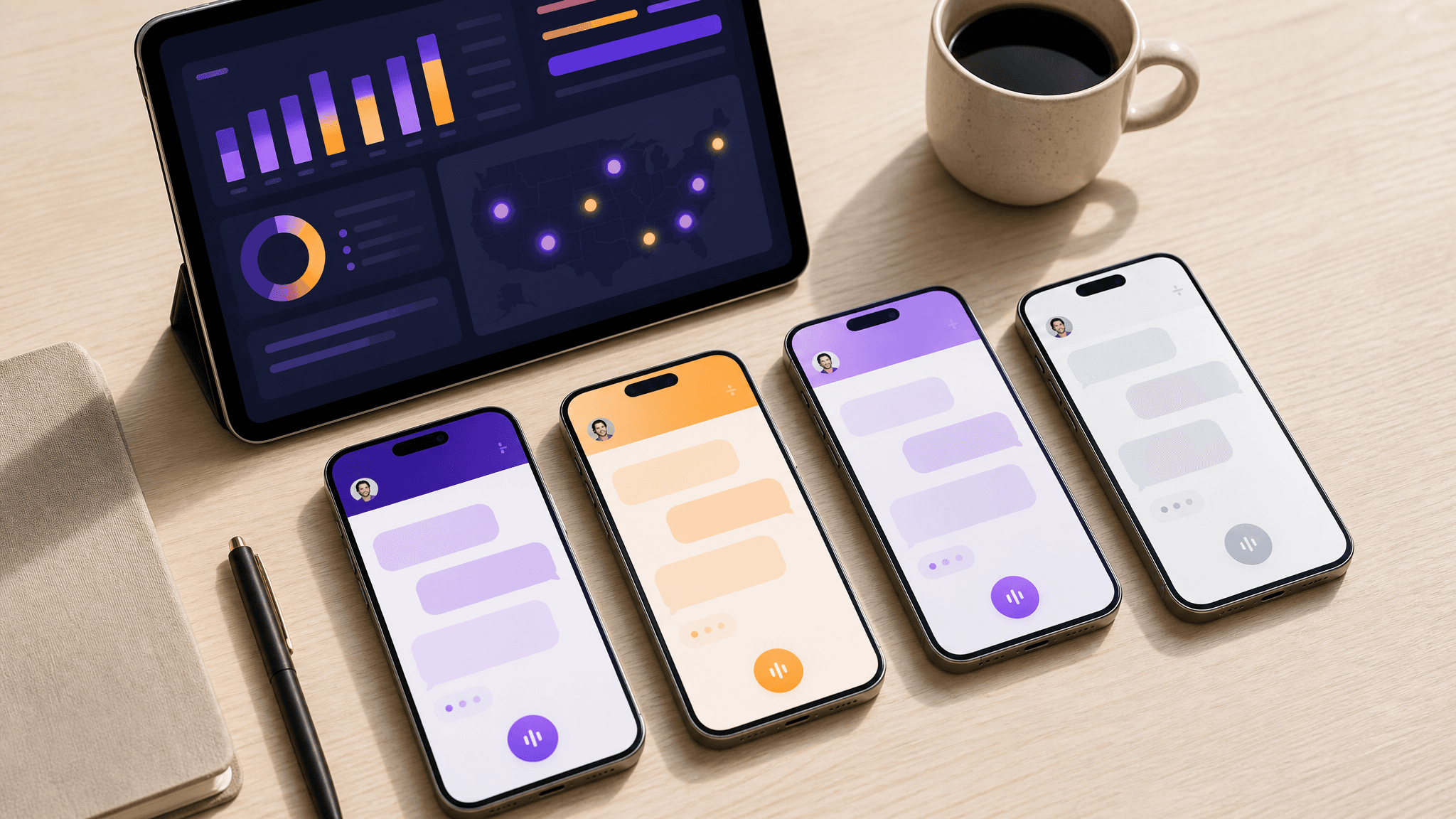
A patient in Tampa opens ChatGPT and types: "best dentist near me for veneers, open Saturdays, takes Delta Dental." Two seconds later they get a short paragraph naming three practices. They tap one and call.
That patient never saw a map pack. They never scrolled ten blue links. They asked a question and a machine answered it for them.
I wanted to know who that machine actually names. So for this report I did what most "AI search is here" articles never do: I ran the patient's question myself, across the four engines that matter, and looked at the answers.
This is v1.0 of what I plan to publish every year. It pairs live testing across ChatGPT, Perplexity, Gemini, and Google AI Mode with patterns I see in the 1,500+ practice analyses my team and I run. The findings below are what I saw in that testing and those analyses. The broader market context is from public research, all cited at the bottom. The goal is simple: give dentists real ground truth about AI search instead of one more hype cycle.
One finding up front, because it reframes everything else: there is no single "AI ranking." Ask the same question to four engines and you often get four different practices. Anyone selling you "we'll rank you #1 in AI" is selling something that does not exist.
How We Built This Report
I want to be transparent about method, because a report is only as good as the way it was made.
The query set. I built a list of patient-style prompts that mirror how people actually talk to an assistant, not how they type into a search box. Things like "where should I go for a cracked tooth today," "good Invisalign dentist near me that takes payment plans," and "is this dentist any good" paired with a real practice name. Conversational, multi-constraint, local.
The engines. I ran each prompt through four surfaces: ChatGPT (with browsing), Perplexity, Google Gemini, and Google's AI Mode. These are the four a normal patient is most likely to touch in 2026.
The practice sample. I cross-referenced the answers against patterns from the 1,500+ practice analyses we run, where I already have the website, the Google Business Profile, the review profile, and the schema for each practice in front of me. That lets me ask the more useful question. Forget who got named for a second. What did the named practices actually have in common?
What this is not. This is not a peer-reviewed study with a controlled national sample. It is a practitioner's field report, run by someone who looks at dental practices for a living. Treat the numbers as directional, not gospel. I tell you exactly where my data ends and the public research begins.
With that said, here is what I found.
Headline Finding: Most Practices Are Invisible to AI
The finding that matters most here is how many practices earn zero mentions across all four engines for their own core, local, money queries.
In my sample, the result was stark. When a patient asked an AI for a dentist who does a specific procedure in a specific place, the large majority of practices did not come up at all. Not lower down on a list. Not at all. Even allowing for a generous margin, the pattern is not subtle. I am deliberately not putting a percentage on that, because my sample is not a national one and a precise-looking number would imply a precision I did not earn. What I can give you instead is the test itself, so you can produce the only number that actually matters to you: your own score.
This matches what the public data implies. AI-driven answers now sit on top of a huge share of informational and local queries, and zero-click behavior, where the user gets their answer without visiting any website, has been climbing for years. Google itself has said AI Mode is the future of Search and has been expanding it to all U.S. users. The surface that decides whether a patient ever sees your name is increasingly an answer, not a list.
If you take one thing from this report: being invisible in AI is not a long-tail edge case. For most practices, right now, it is the default state.
Citation Rate by Practice Type
Not every practice is equally invisible. The clearest split in my sample was by practice type.
- Specialists (oral surgery, perio, ortho, endo) tended to get named more often for their specific procedures. AI is good at matching a narrow service to a narrow provider, and specialists usually have cleaner, more specific service pages and clearer entity signals.
- General practices were the most variable. The ones that got named consistently had deep, specific service pages and a strong, recent review profile. The ones that did not blurred together into "a dentist with a five-page website."
- DSO locations had a particular problem I will come back to: AI frequently confused one location with another under the same brand, or attributed the wrong city, hours, or services to a location. Scale created entity confusion, not entity strength.
The lesson is not "specialists win." The lesson is that specificity wins. AI rewards a practice that has made it unambiguous what it does, where, for whom, and how recently anyone has said so.
The Four Engines Disagree (a Lot)
Here is the finding that should change how you think about AI search.
I expected meaningful overlap between the four engines. There was less than I thought. For the same local query, ChatGPT, Perplexity, Gemini, and AI Mode regularly named different sets of practices. Sometimes only one of three names overlapped between two engines. Sometimes none did.
Why? Because each engine is pulling from a different blend of sources and weighting them differently. Perplexity leans hard on citations it can link. ChatGPT with browsing pulls from what it can fetch in the moment. Gemini and AI Mode lean on Google's own index and the Google Business Profile graph. Different inputs, different math, different answers.
This kills a sales pitch you are going to hear a lot in 2026: "we will get you ranked number one in AI." There is no number one. There is no single ranking to win. There are four (and growing) separate answer engines, each with its own logic. The right goal is not a rank. It is being a defensible, well-described entity that any reasonable engine would feel safe recommending. I wrote about that supply-side work in depth in the dental AEO guide, and about AI Mode specifically in Google AI Mode becoming the default.
The 12-Prompt AI Visibility Test (Run It on Your Own Practice)
Everything above is my read on the market. This part is yours to measure.
The advice everyone gives, mine included, is "go test your practice in AI." That falls apart on the first question a practice owner actually asks, which is "test it with what?" Nobody hands you the prompts. So here they are, with the scoring sheet, because a report you can't run on yourself is just someone else's opinion with a chart on it.
Twelve prompts. A 0 to 2 score on each. One number per engine at the end. About 40 minutes the first time, 20 minutes every quarter after that.
Before you start. Open a brand-new chat, and log out of the assistant or use a private window. An assistant that has watched you type your own practice name for six months will name you, and that answer is worth nothing. Pick one city phrasing and keep it forever, too. "Tampa" and "Tampa FL" are different questions, and if you switch between them you can't compare your score next quarter.
Swap your real city, your highest-value procedure, your top insurance, and your practice name into the brackets.
Visibility: will the machine recommend you?
- best dentist in {city} for {procedure}
- I need an emergency dentist in {city} today
- dentist in {city} that takes {insurance}
- who does {procedure} in {city} with payment plans
- compare the top dental practices in {city} for {procedure}
- best {cosmetic, pediatric, implant} dentist near {neighborhood}
- I just moved to {city}, how do I pick a dentist
- is {practice name} any good
Accuracy: does the machine have your facts right?
- what are {practice name}'s hours
- does {practice name} take {insurance}
- what services does {practice name} offer
- who are the dentists at {practice name}
Score every answer:
| Score | Visibility prompts (1-8) | Accuracy prompts (9-12) |
|---|---|---|
| 2 | Named in the recommendation | The answer is correct |
| 1 | Named only in a source link or a long list, not the recommendation | Partly right, or hedged into uselessness |
| 0 | Not there at all | Wrong, or the engine has no idea who you are |
Add it up. Twenty-four is the ceiling for one engine.
Then do the part everyone skips: run the same twelve prompts in a second engine. ChatGPT plus Google's AI Mode is the pair I would start with. The gap between those two scores is the finding from earlier in this report, measured on your own practice instead of mine, and it is usually wider than people expect.
How to read your number.
| Score, per engine | What it means |
|---|---|
| 0-6 | The engine can't describe your practice specifically enough to recommend it. Start with facts, not tactics. |
| 7-12 | You exist, but you are interchangeable. You get named when the field is thin and dropped when it is not. |
| 13-18 | You are a real candidate. The zeros that remain are almost always one procedure or one insurance the engine does not connect to you. |
| 19-24 | You are the default answer in that engine. Now the job is holding it. |
One rule overrides the score. Circle every prompt where the answer was confidently wrong. A machine telling a patient you close at 3pm when you close at 5, or that you take an insurance you dropped two years ago, is doing more damage than a machine that has never heard of you. Fix those before anything else, whatever your total says. Every one of them traces back to your Google Business Profile, your website, or your structured data, and you control all three.
Write down the date, the engine, and the twelve scores. Re-run it in three months with word-for-word identical prompts. That comparison is worth more than any single score, including mine.
Which Page Elements Correlate With Getting Cited
This is the part practice owners actually want: what did the named practices have that the invisible ones did not?
Across the analyses, the practices that AI named tended to share a short list of traits. I am describing correlation from my own sample, not a controlled experiment, but the pattern was consistent enough to act on.
Specific, deep service pages. Not "Cosmetic Dentistry," but a real page about veneers that answers cost questions, candidacy questions, and process questions in plain language. AI can only recommend you for what your pages clearly say you do.
A current, complete Google Business Profile. Accurate hours, services, categories, and a steady drip of recent reviews. The engines that lean on Google's graph cannot recommend what the graph does not know.
Recent reviews that mention the procedure. A review that says "Dr. Lee did my implant and the whole thing was painless" is a gift to an answer engine. It connects a named provider to a named procedure in natural language, which is exactly what the patient asked for.
Clean structured data. Schema that correctly identifies the practice as a Dentist, its location, its services, and its reviews. It is not a magic ranking lever, but it removes ambiguity, and ambiguity is what gets you left out.
Third-party corroboration. Being described consistently across your site, your profile, and reputable directories. AI trusts a fact more when it sees the same fact in more than one place.
None of these are hacks. They are the same fundamentals good local SEO has always rewarded, now with higher stakes because the output is a single recommendation instead of a list.
Where AI Gets It Wrong
A quieter finding, and maybe the most actionable one: AI confidently gets dental facts wrong all the time.
In testing, I saw assistants state incorrect hours, claim a practice took an insurance it does not, list a service the practice does not offer, and in a few cases recommend a practice that had closed or merged. The machine does not hedge. It says it plainly, and the patient believes it.
For DSO locations the error rate was visibly higher, because the entity confusion I mentioned earlier means the model mixes up which location does what.
This matters for two reasons. First, a wrong answer about your practice can cost you a patient before you ever know they were looking. Second, you can fix a lot of it. The facts AI gets wrong are almost always facts you control: your Google Business Profile, your website, your structured data. Treat your own data hygiene as the cheapest patient-acquisition work you will do this year. I dug into the data-accuracy side of this in the HIPAA and AI piece and the broader practice playbook in the AI stack every dentist should steal.
GBP vs Website vs Third-Party: Where AI Pulls Its Facts
When I traced where the named practices' information seemed to come from, three sources did most of the work.
Google Business Profile was the backbone for the Google-native engines and a frequent source even for the others. If your GBP is thin or stale, you are starting from behind everywhere.
Your website mattered most for the "what do you do and for whom" part of the answer. Deep service pages were the difference between being recommended for a procedure and being passed over for it.
Third-party sources (directories, reviews, local press, professional associations) acted as the tiebreaker and the trust layer. When an engine had to choose between two similar practices, the one with more consistent outside corroboration tended to win the slot.
The practical read: you do not get to pick which source AI uses, so you have to make all three say the same true, specific thing. Consistency across surfaces is the whole game.
What This Means for Your Practice in the Next 12 Months
If you run a practice and you read nothing else, read this.
- Score your own visibility this week. Run the 12-prompt test above in at least two engines and write the numbers down. If the score is low, that is your starting line, not a verdict.
- Fix the facts first. Your GBP and your service pages are the cheapest, fastest levers. Make them accurate, specific, and current before you spend a dollar on anything fancier.
- Stop chasing a rank. There is no single AI ranking. Build a clear, well-corroborated entity and let every engine arrive at the same conclusion on its own.
- Measure influence, not just clicks. AI answers are often zero-click, so your old dashboard will under-count them. I cover how to handle that in the work on attributing AI and zero-click traffic.
This is a 12-month problem to get ahead of, not a weekend project. But the practices that start now will be the ones the machine has learned to trust by the time their competitors realize the list disappeared.
Methodology, Limitations, and the Year-Over-Year Plan
I would rather you trust this report for the right reasons than oversell it.
Limitations. My sample is drawn from the practices I analyze, which skews toward practices already investing in growth. AI answers also vary by location, by phrasing, by personalization, and literally by the hour, because these systems change constantly. Re-running the same prompt tomorrow can produce a different answer. That instability is itself a finding.
Why publish it anyway. Because directional truth from someone who looks at the data beats another vendor's vibes. And because the only way to measure change is to start measuring.
The plan. I will re-run an expanded version of this annually, hold the query set roughly stable, and report what moved. Over a few years that becomes the thing the industry does not have right now: a time series of how dental AI search actually behaves.
If you want me to run this analysis on your own practice, ask the four engines about you and bring me the answers, request a free competitive analysis and mention "AI visibility" so I know to test your name across all four engines and show you exactly where you stand.
The patient in Tampa is already asking. The only question is whether the machine knows your name when they do.
Go deeper: More from the AI in Dentistry hub: answer engines, AI Mode, and how practices show up when patients ask a machine.
Sources
- Google: Generative AI in Search and the expansion of AI Mode: Google, official announcements on AI Overviews and AI Mode rolling out to U.S. users as a default Search experience
- Google Search Central: AI features and your website: Google, documentation on how content surfaces in AI experiences and the fundamentals that still apply
- Pew Research Center: Americans' use of AI chatbots: Pew Research Center, survey data on the share of U.S. adults using AI assistants and how that adoption is growing
- BrightLocal: Local Consumer Review Survey: BrightLocal, annual data on how consumers use reviews and online sources to choose local businesses, including healthcare
- Search Engine Land: AI Overviews and zero-click search trends: Search Engine Land, ongoing coverage of AI Overviews coverage rates and the rise of zero-click answers
- American Dental Association: practice management and patient communication: American Dental Association, benchmarks on patient acquisition and the role of digital discovery in choosing a dentist
Keep reading
All articlesWant to see this in action for your practice?
Book a free discovery call and I'll run a competitive analysis. On the house.
Book a Discovery Call