The Perfect Veneers Landing Page (2026)
Pete Johnson
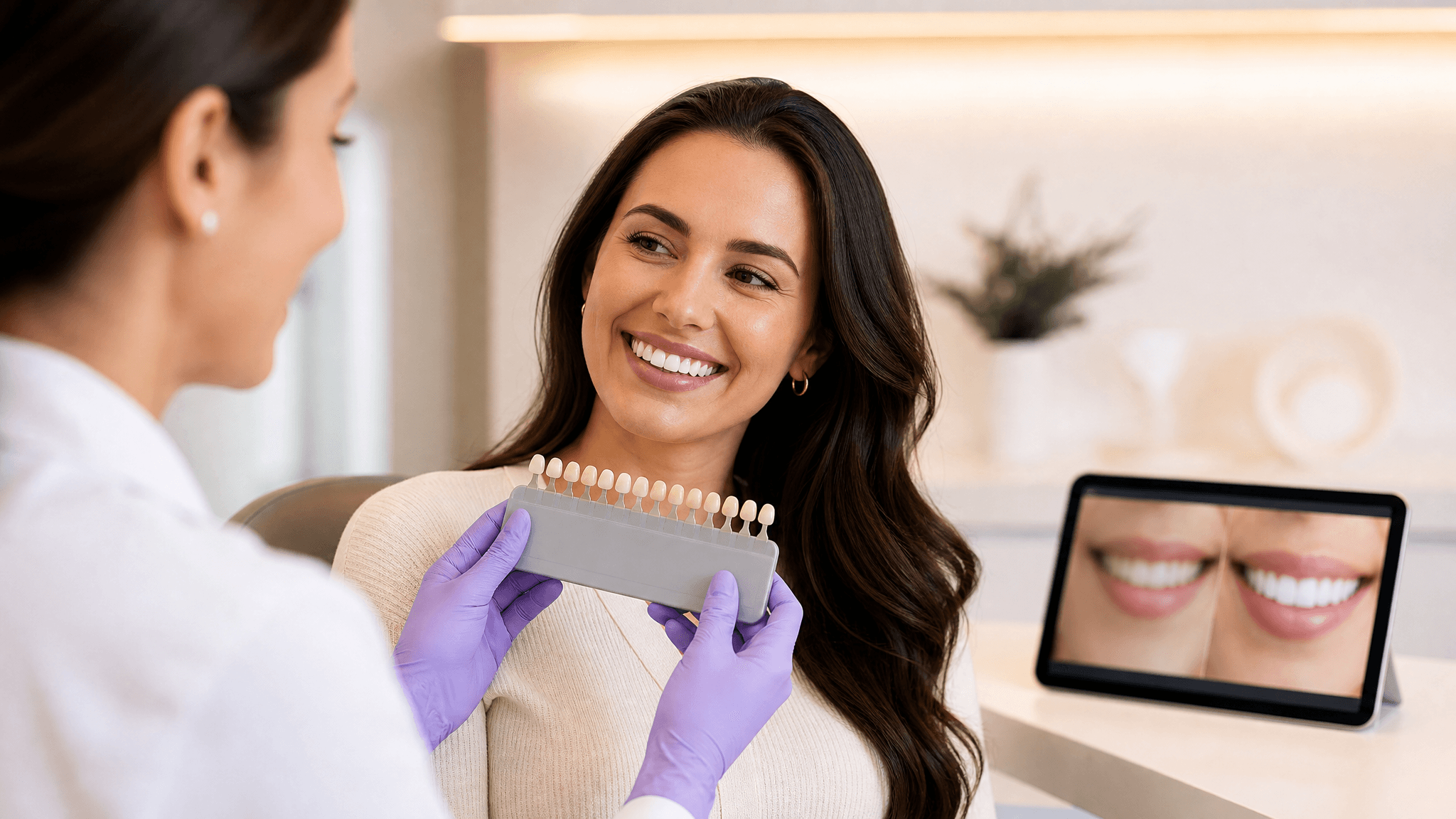
A veneers patient is buying a feeling, not a procedure.
That's the whole game, and most veneers landing pages miss it completely. Implants fix a problem. Invisalign corrects a bite. Veneers are someone deciding they want to look different when they smile in a photo, in a meeting, on their wedding day. That's a want, not a need. Wants get talked out of. Wants need proof.
So when I audit a cosmetic dentistry website (I've personally torn down over 2,500 dental practices), the veneers page is almost always the one that breaks my heart. The dentist does gorgeous work. The page is a stock photo of a model who was never a patient, two paragraphs about "Hollywood smiles," and a button that says "Learn More."
That page leaks more money per visit than any other service page on the site. A veneers case isn't a $300 filling. Porcelain veneers run roughly $1,000 to $2,500 per tooth, and a real smile makeover is 6 to 10 teeth. So the patient reading that thin little page is deciding whether to spend somewhere between $6,000 and $25,000 with you.
Quick answer: The perfect veneers page is built around a real before/after gallery of the dentist's own cases. That gallery is the page; everything else supports it. Around it you need an honest price range ($1,200 to $2,200 per tooth, $8,000 to $22,000 for full cases), financing with monthly framing, and direct answers to the fear questions like "do veneers ruin your teeth." The CTA is worded for someone buying a feeling, not booking a cleaning: think "Book a Smile Consultation," not "Schedule an Appointment."
Here's what the perfect veneers landing page needs in 2026.
Why is the veneers page different from every other service page?
Because veneers are a want, not a need, and the page has to handle aspiration, fear, and price all at once. The implant patient is anxious about surgery. The Invisalign patient is comparing you to a mail-order brand and a price. The veneers patient is on the couch at 11pm looking at other people's teeth, asking could mine look like that? That's an aspirational decision they're trying to give themselves permission to make, and three forces pull on them at once:
- The aspiration. They've seen veneers on a celebrity, an influencer, a coworker who suddenly looks great. They want it.
- The fear. They've also seen the horror stories. "Veneers ruined my teeth," the chiclet look, the guy whose veneers fell off on a podcast. They're scared of looking fake or getting butchered.
- The price. It's a lot of money for something nobody is forcing them to do.
A veneers landing page that doesn't speak to all three is just a brochure. Patients don't book brochures.
The before/after gallery is the entire page (everything else supports it)
If you take one thing from this post, take this. For veneers, the before/after gallery is not a section of the page. It is the page. Everything else just supports it.
Think about how you'd buy this. You wouldn't read a paragraph about the dentist's philosophy and call. You'd look at smiles, hunting for a "before" that looks like yours and an "after" that looks like the version of you you're paying for. That's the conversion event. So the gallery has to be:
- Real patients, not stock. Non-negotiable. The second a patient suspects those are stock images or someone else's cases, the page loses trust. Cosmetic patients are savvy. They've been looking at smiles for weeks.
- The dentist's own work. Your biggest differentiator. Two dentists can both "do veneers." Only one shows their hands on their cases. This is an aesthetic skill, like a haircut or a tattoo. Patients hire an eye, and the only way to prove an eye is to show it.
- High resolution and well lit. Bad photography of great work reads as bad work. Yellow lighting and blur, and the patient assumes the result is blurry too.
- Varied cases. Gaps, discoloration, worn-down teeth, old failing veneers. The patient needs to find the "before" that matches their mouth.
- Natural-looking results. Your best marketing is results that don't scream "veneers." A gallery of natural, age-appropriate smiles sells harder than a row of blinding white chiclets.
If your practice invests in one asset for this page, make it a real photo shoot of your actual veneer cases. At Lasso we fold an in-office shoot into bigger engagements for exactly this reason: first-party proof is what makes a cosmetic page convert.
What needs to be above the fold on a veneers page?
Five things: the word "veneers" plus your city in the H1, a real "after" smile from your own chair, an honest price range, financing with monthly framing, and a consult CTA worded for an aspirational buyer. They're not the same five as the implants page, because this buyer isn't solving a problem. They're giving themselves permission.
1. The word "veneers," and the city
Say it in the H1. The real word. Not "Smile Transformations," not "Aesthetic Restorations." Patients search veneers, so use it: Porcelain Veneers in [City] or Veneers & Smile Makeovers in [City]. If you do a recognizable technique (no-prep, same-day, a named smile-design process), name it early. Patients hunting for a specific approach want that signal.
2. A real "after" smile, immediately
Your hero image should be one of your best real cases. Not a model, not a stock close-up of shade tabs. An actual patient who got an actual result in your chair. The aspiration has to be on screen before they scroll.
3. The price, or at least an honest range
This is where 90% of veneers pages chicken out. They hide the number and make you call. Don't. "Every case is different" is not a reason to say nothing. It's a reason to give a range and explain what moves it. Something like this lives near the top:
Porcelain veneers in our office typically run $1,200 to $2,200 per tooth. Most smile makeovers involve 6 to 10 veneers, so full cases generally land between $8,000 and $22,000. We offer financing, and we'll give you an exact written quote at your consultation.
That paragraph qualifies the patient who can afford it, filters out the one who can't, signals confidence, and answers the question they're most afraid to ask out loud. People don't trust prices they have to extract.
4. Financing, up front
Veneers are elective and expensive, so financing isn't a footnote, it's part of the offer. A 9-tooth case at $18,000 versus $310 a month are two different decisions in the patient's head. Put the monthly framing where they'll see it, before they talk themselves out of the idea on the total.
5. A consult CTA that fits the buyer
"Schedule an Appointment" is wrong for this buyer: too clinical, sounds like a cleaning. Better fits:
- Book a Smile Consultation
- See If Veneers Are Right for You
- Get Your Smile Makeover Plan
If you offer a free consult, a digital mockup, or a smile simulation, lead with it. "Free" and "preview" both crush "appointment" because they lower the commitment of the first step. The patient isn't ready to commit to $18,000. They're ready to find out what their smile could look like. Phone number next to it, click-to-call on mobile.
What questions does a veneers page have to answer before patients bounce?
Five questions carry the whole page: how much do veneers cost, are they worth it, do they ruin your teeth, how long do they last, and veneers vs. Invisalign. Answer those directly and you close the gap between I want this and I booked it. Same logic I laid out for the perfect Invisalign landing page and the perfect dental implants page: answer the real questions before the patient leaves to ask someone else.
- How much do veneers cost? Make the number yours, with your context attached, before Google hands them a scary one.
- Are veneers worth it? The permission question. Name what veneers actually fix (discoloration that won't whiten, gaps, chips, worn edges) and don't oversell.
- Do veneers ruin your teeth? The fear question, and most pages pretend it doesn't exist. Address it head-on and be the only page brave enough to name it.
- How long do veneers last? Be straight: 10 to 15 years, often longer, not strictly permanent.
- Veneers vs. Invisalign? Searchers are confused about whether they want to straighten or cover. An honest comparison makes you the guide, not the upsell.
These are the exact questions patients now type into ChatGPT and AI Overviews. Answer them well and you win the booking and the citation, which is the whole game in dental AEO. Copy-ready versions are in the FAQ below.
The content blocks I'd build, in order
If I were rebuilding a veneers page tomorrow, here's the skeleton, in order. Note where the gallery sits: second, not seventh.
Veneers page elements checklist
| # | Element | Conversion job |
|---|---|---|
| 1 | Hero | H1, a real "after" smile, consult CTA, phone number, review proof |
| 2 | Before/after gallery | Your closer, high up. Don't make people scroll past everything to reach it |
| 3 | Is this for you? | The problems veneers fix, in scannable bullets |
| 4 | Cost & financing | Honest ranges and monthly framing |
| 5 | Meet your cosmetic dentist | Real photo plus credentials. Where you prove the eye |
| 6 | How it works | Consultation, smile design, prep, temporaries, final placement |
| 7 | Veneers vs. the alternatives | Invisalign, whitening, bonding. Be the honest guide |
| 8 | FAQ | The block AI cites. Coming up next |
| 9 | Reviews | Filtered for the result, feeling confident, the dentist's artistry |
| 10 | Final CTA | One step. Booking link, phone number |
That order is deliberate. The gallery is the conversion event, so it goes right under the hero, and everything below it exists to remove the reasons not to book.
Trust signals: prove the eye, not just the license
Every dentist has a license. That's table stakes and convinces nobody on a cosmetic case. For veneers, the signals that move the needle prove aesthetic skill specifically:
- AACD membership or accreditation. The American Academy of Cosmetic Dentistry accreditation is one of the few credentials patients can actually look up that signals cosmetic skill. If your dentist has it, it belongs on the page.
- Volume of cosmetic cases. "Over 800 veneers placed" or "15 years designing smiles" beats "experienced and caring" every time. One specific number outperforms five vague adjectives.
- The dentist's own portfolio. Their work. I keep coming back to this because it's the whole ballgame.
- Reviews that mention aesthetics. Not "great cleaning." Reviews that say "I finally love my smile" or "you can't even tell they're veneers." Filter for those. If your review mix doesn't surface them, here's how to fix that.
What does NOT build trust: a stock photo of a dentist who isn't yours, generic "state of the art technology" copy, a wall of logos nobody recognizes. Cosmetic patients smell generic from a mile away.
The FAQ section (this is what AI quotes)
Veneers is a category flooded with questions in Google's AI Overviews, ChatGPT, and Perplexity. Patients ask "are veneers worth it" and "do veneers ruin your teeth" before they ever land on a practice site. Clean, direct FAQ answers are what those systems pull from, and a well-structured FAQ block is how you get cited in the answer instead of buried under it.
The best entries match the real question, answer in the first sentence, add a detail or two, and skip the fluff. Examples:
How much do veneers cost?
Porcelain veneers typically cost $1,200 to $2,200 per tooth. Because most smile makeovers use 6 to 10 veneers, full cases generally range from $8,000 to $22,000. Financing is available, and we provide an exact written quote at your consultation.
Are veneers worth it?
For patients who want to correct discoloration, gaps, chips, or worn teeth that whitening and bonding can't fully fix, veneers are often worth it because the results are dramatic and long-lasting. The right answer depends on your goals, which is what a consultation is for.
Do veneers ruin your teeth?
No, when placed properly by an experienced cosmetic dentist, veneers do not ruin your teeth. Traditional veneers involve removing a thin layer of enamel, while minimal-prep and no-prep options preserve more of the natural tooth for candidates who qualify.
How long do veneers last?
Porcelain veneers typically last 10 to 15 years, and often longer with good oral hygiene and regular checkups. They're not permanent and will eventually need replacement, but they're a durable, long-term cosmetic solution.
Should I get veneers or Invisalign?
Invisalign straightens your natural teeth by moving them, while veneers reshape and recolor the teeth without moving them. If your main concern is alignment, Invisalign may be the better fit. If it's color, shape, gaps, or chips, veneers usually are. Some patients do a short course of Invisalign first, then veneers.
Those answers convert a hesitant patient and get repeated by an AI to the next ten. Both matter, and they cost you nothing but a little honesty.
Schema and the technical layer
Don't overthink it, but don't skip it. For a veneers page you want:
- A clean H1 with service + city, and a logical H2 structure (the questions above make great H2s).
- FAQPage structured data on the FAQ block. Google retired the FAQ rich result, so this buys you no dropdown. Mark it up anyway and put the real work into the visible answers, because "how much" and "is it worth it" are exactly what AI Overviews quote on a cosmetic page.
- LocalBusiness or Dentist schema at the site level, plus ImageObject markup with descriptive alt text on the gallery.
- Internal links from your whitening, bonding, and Invisalign pages into this one.
Then the basics: fast load speed (veneers pages are image-heavy, so compress hard and lazy-load below the fold), mobile-first, and click-to-call. A gorgeous gallery that takes eight seconds to paint is a gallery nobody sees. If the page is slow, hides the price, and shows stock smiles, no schema on earth saves it. Same point I made in why most dental websites don't convert, doubly true for the highest-ticket cosmetic page on your site.
The mistakes I see on basically every veneers page
I've seen these so many times I could write them in my sleep:
- Stock-photo smiles. The cardinal sin. You're selling your eye and showing someone else's mouth.
- Hiding the price. "Call for pricing" tells the patient you're either expensive and ashamed of it, or about to high-pressure them on a call. Neither builds trust.
- No financing in sight. Making a patient do the $18,000 math with no monthly framing is how you lose them on the total.
- Burying the consult CTA. One vague "Contact Us" in the header doesn't count. It should be impossible to miss and worded for an aspirational buyer.
- Generic copy with no aesthetic point of view. "We create beautiful, natural-looking smiles using the latest technology" means nothing and could live on any of ten thousand sites. It proves no eye, no taste, no skill.
- The gallery shoved to the bottom. Putting your single best conversion asset under four paragraphs of fluff is leaving money on the floor.
Fix those six things and you're ahead of nearly every cosmetic dentist in your market. I mean it.
The short version
The perfect veneers landing page in 2026 isn't the slickest one. It's the most honest one, wrapped around the most real proof.
Show the dentist's actual before-and-after work, high up and in high resolution. Put a real price range on the page. Make financing obvious. Answer the worth-it question and the do-they-ruin-your-teeth question instead of pretending nobody's asking them. Word the CTA for someone buying a feeling, not booking a cleaning. Keep it fast.
Because the patient looking at veneers tonight is on their phone, comparing your smiles to three other dentists' smiles, deciding whether the version of themselves they want is worth $18,000.
Show them it's real, and that you're the one with the eye to deliver it.
If your cosmetic page is a stock photo and a "Learn More" button, that's the most expensive button on your website. Let's fix it. Book a free teardown of your practice's website and I'll show you exactly where your veneers page is losing cases.
Sources
- Removing the FAQ rich result, Google Search Central
- Local Business structured data, Google Search Central
- Accreditation and Find a Cosmetic Dentist, American Academy of Cosmetic Dentistry
- Veneers Patient Information, American Dental Association (MouthHealthy)
Keep reading
All articlesWant to see this in action for your practice?
Book a free discovery call and I'll run a competitive analysis. On the house.
Book a Discovery Call