Local Services Ads for Dentists: Is the Google Screened Badge Worth It?
Pete Johnson
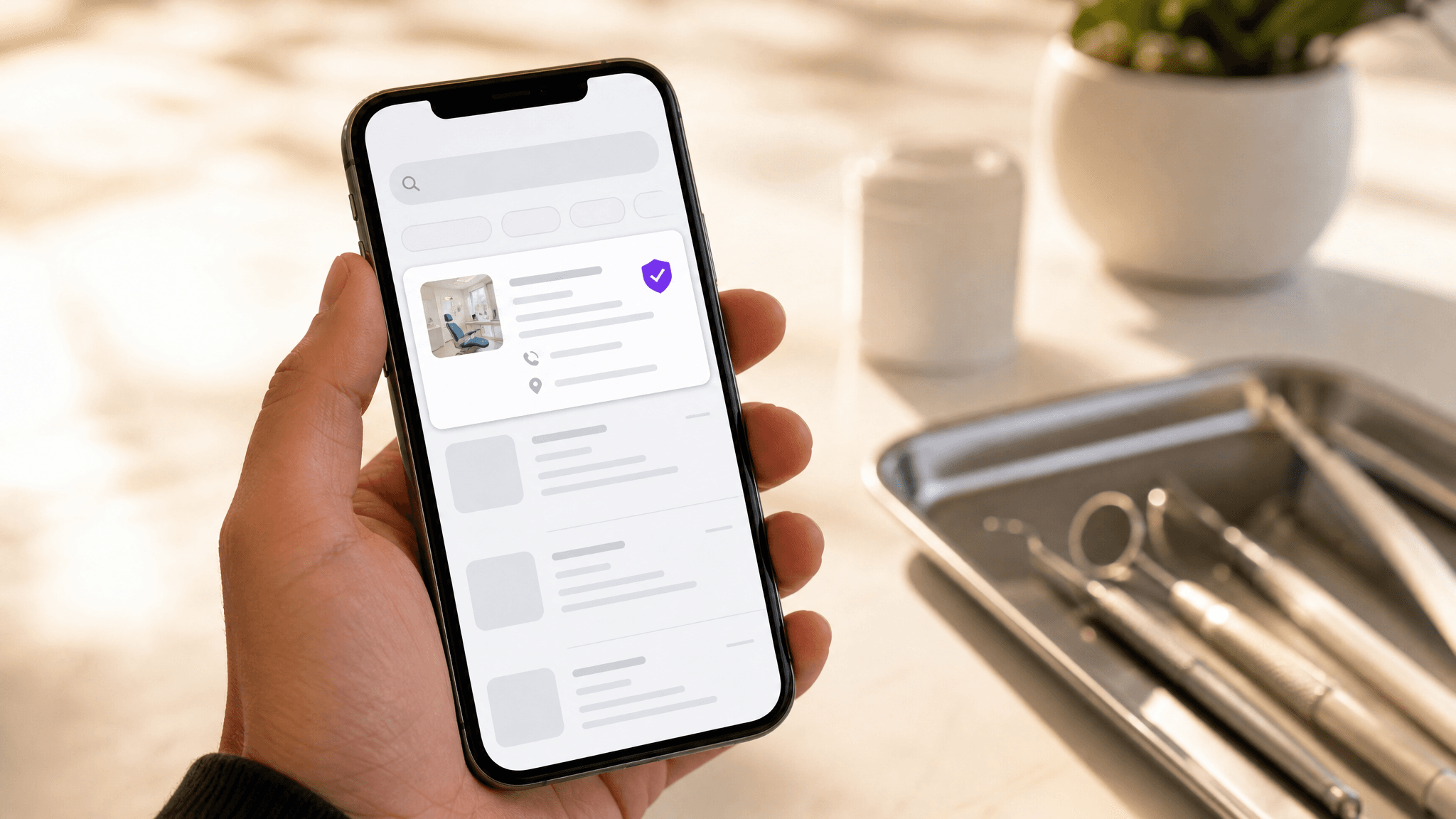
There's a slot at the very top of Google search results that most dentists I talk to have never paid for. It sits above the regular Google Ads, above the map pack, above the organic results. It comes with a star rating, a little blue checkmark that says Google Screened, and a button that lets a patient call or message you without ever visiting your website.
That slot is a Local Services Ad. And as Google's AI Mode keeps eating the organic real estate underneath it, that top spot is getting more valuable by the month.
I've analyzed 2,500+ dental practices at Lasso MD, and Local Services Ads come up in almost every conversation about paid search now. Most owners have either never heard of them or have a vague sense that "Google verifies you somehow." So let me walk through what these actually are, how they're different from the Google Ads you already know, and whether the Google Screened badge is worth chasing for a dental practice.
One honest caveat up front, because I'd rather you trust me than oversell you: availability for healthcare and dental varies by category and by market. I'll be clear about where the lines are.
Quick answer: Local Services Ads put your practice above the map pack and the AI box with a Google Screened badge, and you pay per lead instead of per click. For most eligible practices they're worth testing, if your reviews are strong, your front desk answers fast (responsiveness is an actual ranking input), and you track whether leads become booked patients. Verification takes roughly two to four weeks, availability varies by market, so confirm eligibility in a Google Local Services account before you build a plan around it.
What are Local Services Ads?
Local Services Ads (LSAs) are a separate Google product from the standard search ads you've been running. They appear above the map pack and the regular text ads, show your star rating and a Google Screened badge, and charge you per lead instead of per click. They're built for local service businesses, and they work on a fundamentally different model.
Here's what a patient sees. They search something like "dentist near me." Before the map, before the blue links, before even the regular text ads, they get a row of practices showing:
- Your practice name
- Your Google star rating and review count
- A Google Screened badge (the blue checkmark plus verification)
- A button to call or send a message
Tap the button, you get the lead. No landing page in between. The whole thing is engineered to turn a search into a phone call with as little friction as possible.
The part that trips people up: you pay per lead, not per click. Google's own documentation spells this out. You're charged when a patient calls or messages through the ad, not every time someone taps it out of curiosity. If you get a lead that's spam, a wrong number, or clearly outside what you offer, you can dispute the charge and Google credits it back.
That pay-per-lead structure changes the math completely, which brings me to the comparison everyone wants.
How are Local Services Ads different from regular Google Ads?
Three differences: you pay per lead instead of per click, ranking is driven by proximity, reviews, and responsiveness instead of a pure bid auction, and you have to pass license and background verification before anything runs. You trade the granular keyword control of PPC for the top slot and a trust badge.
LSAs vs. regular Google Ads
| Local Services Ads | Regular Google Ads (PPC) | |
|---|---|---|
| You pay for | Leads (calls/messages) | Clicks |
| Ranking driven by | Relevance, proximity, reviews, responsiveness | Bid auction + Quality Score |
| Setup | License, insurance, background check (roughly 2-4 weeks) | Live in an afternoon |
| Placement | Above the map pack and text ads | Below LSAs |
| Bad leads | Disputable for credit | You pay for tire-kickers too |
If you already run Google Search Ads (PPC), you know the model: you bid on keywords, Google runs an auction, your ad shows, you pay every time someone clicks. Quality Score, bid strategy, the whole machine. (If that machine is changing under you, I wrote about Google retiring broad match and folding everything into AI Max recently.)
Local Services Ads throw most of that out.
You pay per lead, not per click. A tire-kicker who taps your LSA and bounces costs you nothing. A patient who calls and books costs you one lead fee. With traditional PPC, you pay for the tire-kicker too.
Ranking isn't a pure bid auction. Your budget matters, but it's not the lever it is in search ads. Google places Local Services Ads based on relevance, proximity to the searcher, your review score, and your responsiveness. Per the Local Services Help docs, how fast you answer calls and reply to messages is an actual ranking input. A practice four blocks away that picks up the phone in two rings can outrank a bigger practice across town that lets calls roll to voicemail.
Setup is verification, not just a campaign. With regular Google Ads you write copy, set a budget, and you're live in an afternoon. Local Services Ads make you earn the badge first. For the Google Screened badge in healthcare, that means submitting your license, showing proof of professional liability insurance, and consenting to a background check for the practice owner. Industry guides put the review window at roughly two to four weeks. That gate is the whole point. The badge means something because not everyone has it.
So the trade is real. You give up the granular keyword control of PPC. In exchange you get the top slot, a trust badge, and a model where you're paying for actual patient contact instead of clicks.
Can every dentist run Local Services Ads?
No. Dentistry is an approved category, but Google decides which categories run in which markets, and thin markets may not offer Local Services Ads at all. The only way to know for sure is to enter your category and city in a Google Local Services account and let Google tell you. It takes five minutes.
Here's where I have to slow you down, because a lot of agency blogs will tell you every dentist everywhere can run these today. That's not quite true, and I'm not going to pretend it is.
Local Services Ads rolled out by industry, one vertical at a time. For years it was home services: plumbers, locksmiths, electricians. Healthcare came later, and dentistry was actually the first medically related category Google opened up, per Dental Economics. So as a category, dentists are in the door. That's the good news.
The caveats that still apply:
- Eligibility is checked by category and location. Google decides which service categories run in which areas. In thin markets, where there isn't much search volume or there aren't enough dentists who want to participate, Google may not offer Local Services Ads at all.
- The badge is conditional. Google Screened in healthcare requires that license and insurance verification, and you have to keep your credentials current. Let your license or insurance lapse and the badge can drop.
- Rollout has been uneven over time. Availability and the exact verification flow have shifted as Google expands the program, so what was true for a market last year may differ now.
What this means for you: do not take my word, or any blog's word, that you specifically can run them. Confirm it. Log into a Google Local Services account, enter your category and your city, and let Google tell you what's available in your actual market. If you're eligible, the signup flow will say so and walk you into verification. If you're not, you'll find out in five minutes instead of building a whole plan around a slot you can't buy.
I'd rather you spend five minutes confirming than build a plan on a yes that isn't there.
Why do Local Services Ads matter more right now?
Because Google's AI Mode and AI Overviews are compressing the organic results, and the Local Services Ads slot sits above the AI box in a lot of layouts. When the free real estate shrinks, the paid real estate at the very top gets more valuable.
If Local Services Ads have been around for a while, why am I writing about them now? Because the ground underneath them is shifting.
Google's AI Mode and AI Overviews are compressing the organic results. The AI-generated answer box and the conversational results are pushing the classic local map pack down the page, and in a lot of dental searches roughly two-thirds of practices are losing the organic visibility they used to count on. I broke that pattern down in my piece on how AI search is rewriting dental discovery.
While everyone is fighting over a smaller organic pie, that top row keeps its position.
This is a cost-per-new-patient conversation, not a "shiny new ad type" conversation. The math only works if a lead turns into a booked, high-value patient often enough to justify the per-lead fee. If you don't already know your patient acquisition cost and your patient lifetime value, that's the homework to do first. The 2026 benchmarks give you the baselines by channel, I laid out the real numbers in how much a dentist should actually spend on marketing, and the framework for tracking whether any channel pays off is in how to track dental marketing ROI. Run those before you turn this on, not after.
How does a dental practice get started with LSAs?
Five steps: create a Google Local Services account, pass license and insurance verification (plan for a couple of weeks), get your reviews in order, set a weekly lead budget, and answer the phone fast. Nothing runs until the Google Screened badge is approved.
If you confirm you're eligible, here's the rough path.
- Create a Google Local Services account for your practice and select your dental category and service area.
- Pass verification. Submit your dental license, proof of liability insurance, and clear the background check for the owner. Plan for a couple of weeks. Nothing runs until the badge is approved.
- Get your reviews in order. Your Google review count and rating feed directly into where you rank. A practice with 200 reviews at 4.8 stars is starting from a different place than one with 30 reviews at 4.2. (If reviews are a weak spot, that's a fixable problem, and I wrote the full review system playbook worth running regardless.)
- Set a weekly lead budget, which is closer to a pacing dial than a bid. Google translates it into roughly how many leads you're willing to receive.
- Answer the phone. Fast. This is the one most practices fumble. Responsiveness is a ranking factor and it's the difference between paying for a lead and converting it. A missed call here isn't just a lost patient, it's a lead fee with nothing to show for it.
That last point is where practices self-sabotage. You can win the top slot and still light money on fire if your front desk lets calls go to voicemail at lunch.
The Honest Pros and Cons
Let me lay it out straight, because every ad product has a catch.
LSA pros and cons at a glance
| Genuinely good | Go in clear-eyed |
|---|---|
| Top placement above the map pack and AI box | Lead disputes are a chore you have to keep up with |
| High-intent leads far down the decision funnel | Eligibility and category limits vary by market |
| Pay-per-lead pricing with disputable bad leads | Responsiveness is non-negotiable |
| Google Screened trust badge | One slot, not a full strategy |
What's genuinely good about Local Services Ads:
- Top placement above the map pack and the AI box, which is the most valuable spot on the page right now.
- High-intent leads. Someone tapping "call" on a dentist result is far down the decision funnel.
- Pay-per-lead pricing. You're buying patient contact, not clicks, and invalid leads are disputable.
- The trust badge. Google Screened is a real differentiator when a patient is choosing between three practices they've never heard of.
What you need to go in clear-eyed about:
- Lead disputes are a chore. You only get credited for bad leads if you flag them. That means reviewing leads and call recordings regularly. Skip it and you'll quietly overpay.
- Eligibility and category limits are real. Covered this above. Some markets and categories just aren't available, and that's outside your control.
- Responsiveness is non-negotiable. If your office can't answer calls fast and consistently, this channel will underperform and cost you ranking.
- It's not a full strategy. Local Services Ads are one slot. They don't replace SEO, your website, your reviews engine, or your regular paid search. They sit on top of all of it.
So, Is the Google Screened Badge Worth It?
For a lot of practices, if you're eligible: yes, worth testing. The top placement is real, the pay-per-lead model is friendlier to a tight budget than per-click, and the badge buys trust you'd otherwise spend months building. As AI keeps squeezing the organic results, owning that top slot gets more defensible, not less.
But "worth testing" is doing real work in that sentence. Worth it if you confirm eligibility in your actual market, if your reviews are strong enough to rank, if your front desk answers the phone, and if you actually track whether those leads turn into booked patients. Miss any of those and you've got an expensive badge.
Start with the five-minute eligibility check. Then run the cost-per-patient math. Then decide.
If you want a second set of eyes on whether Local Services Ads make sense for your specific market, and a look at where your current paid search is leaking money, that's exactly the kind of thing I dig into on a 20-minute discovery call. No pitch, just a straight read on where your ad spend is actually going.
Pete Johnson is the Cofounder & VP of Sales & Strategy at Lasso MD. He's analyzed 2,500+ dental practices and speaks at dental conferences nationwide on competitive analysis, marketing ROI, and practice growth.
Sources
- How leads work, Google Local Services Help
- Local Services Ads ranking, Google Local Services Help
- Google Local Services Ads signup, Google Ads
- Dentists now allowed to use Google Local Service Ads, Dental Economics
- Healthcare and medicines advertising policies, Google Advertising Policies Help
- The Ultimate Guide to Google's Local Services Ads, WordStream
Keep reading
All articlesWant to see this in action for your practice?
Book a free discovery call and I'll run a competitive analysis. On the house.
Book a Discovery Call