The Dental Front-Desk Call-Scoring Scorecard
Pete Johnson
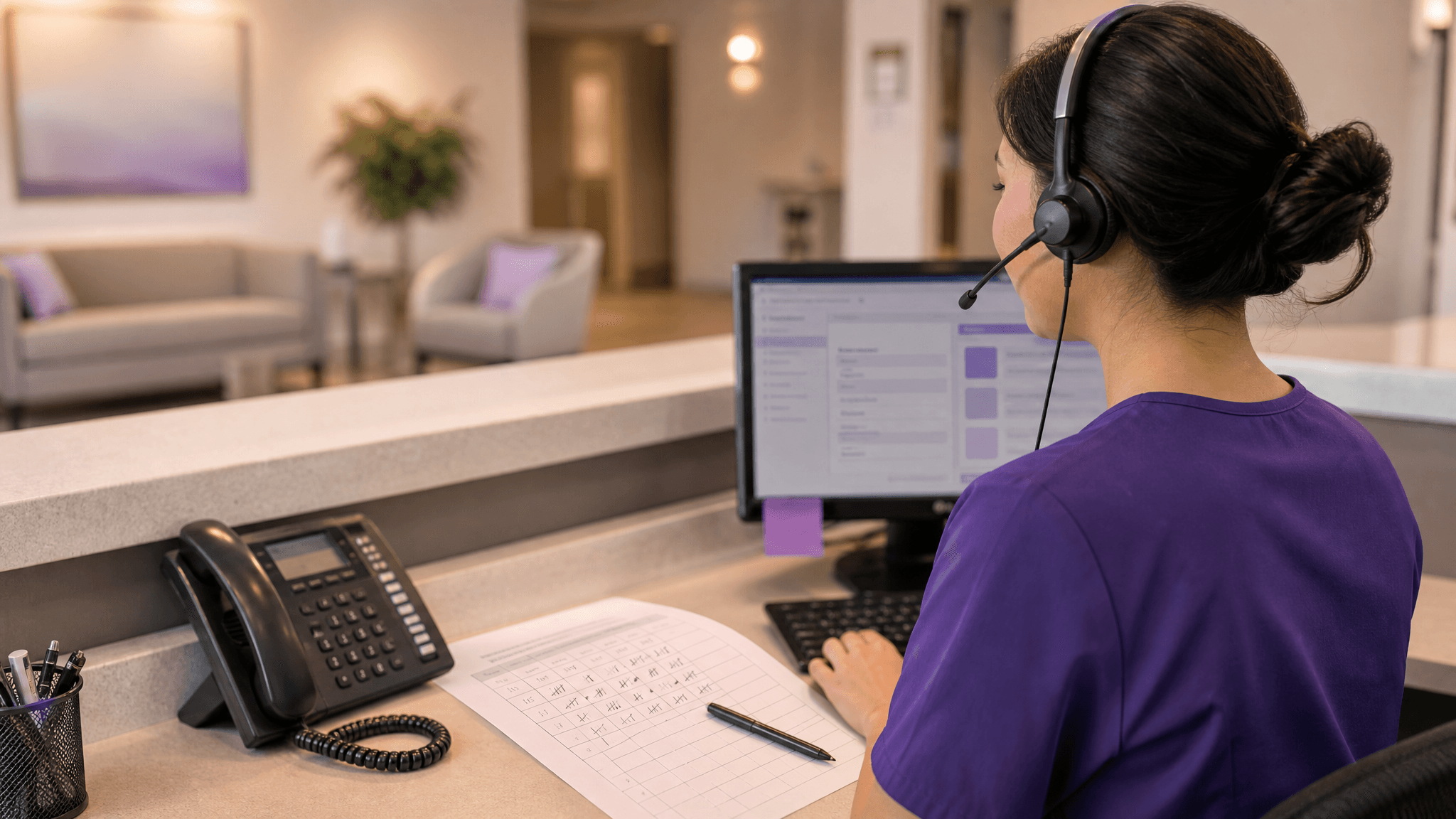
Your practice spends real money to make the phone ring. Ads, SEO, your Google Business Profile, referrals. And then, for a lot of practices, the most expensive moment in the entire funnel happens with no system at all: the live new-patient phone call.
That call is where marketing spend becomes revenue or evaporates. A new patient who calls is worth far more than a click, because they raised their hand and dialed. Yet most practices have no repeatable way to measure or improve what happens on that call. It is the cheapest growth lever in dentistry and the one almost nobody actually pulls.
So here is the tool. A simple, printable scorecard you can use to score new-patient calls, a 20-minute weekly routine to run it, and a 30-day plan to lift your booking rate. No new software. Just attention paid to the moment that matters most.
This is the tactical, on-the-phone companion to you do not have a new patient problem, which makes the strategic case: most practices do not need more leads, they need to convert the ones they already have. That post is the why. This is the how, at the desk, this week.
Why the Phone Is the Cheapest Growth Lever
Run the math in your head. If you are converting, say, half of your new-patient calls into booked appointments, then every improvement to that conversion rate is pure profit on traffic you already paid for. Lifting your booking rate by even ten points can add more production than doubling your ad budget, and it costs you almost nothing because the calls are already coming in.
The research on response and conversion in service businesses is consistent: speed and quality of the human interaction drive whether an interested person becomes a customer. In dental, where a patient in pain or anxiety is often calling two or three practices at once, the call is frequently the entire competition, decided in ninety seconds.
And yet the call is the least-measured part of most practices. Owners obsess over ad dashboards and never once listen to how their highest-value moment actually sounds. The scorecard fixes that.
The Companion Play: Strategy There, Tactics Here
Quick framing so you use both tools right.
You do not have a new patient problem covers the system: the two-call rule, speed-to-lead, missed-call recovery, and working unscheduled treatment. That is the strategy layer, the policies that decide whether opportunities get a fair shot.
This scorecard is the tactics layer: what good actually sounds like on a single call, and how to coach toward it. Strategy without tactics is a nice memo nobody acts on. Tactics without strategy is a team trying hard with no system behind them. You want both. Read that post for the policies, use this for the practice.
The Anatomy of a New-Patient Call That Converts
Before the scorecard, understand the shape of a great call. It is not a hard sell. It is a warm, confident guide moving a nervous person toward a yes.
A converting call does five things well. It makes the caller feel welcomed in the first ten seconds. It quickly understands why they are calling and what they are worried about. It conveys, briefly and genuinely, why this practice is a good choice. It handles the money and insurance questions without flinching or losing them. And it actually asks for the appointment and offers specific times, instead of ending with a vague "give us a call back."
That last part is where most calls die. The team answers questions beautifully and then never asks for the booking. The scorecard makes that failure visible.
The Call-Scoring Scorecard
Here is the scorecard. Ten criteria, each scored 0, 1, or 2. Zero means it did not happen, 1 means partial, 2 means done well. Twenty points possible. Score a call by listening to a recording or sitting in, and mark each line.
- Prompt, warm answer. Picked up quickly, with a friendly greeting and the practice name. (0-2)
- Got and used the caller's name. Asked for it early and used it during the call. (0-2)
- Identified the real reason for the call. Surfaced the chief concern, including any pain, anxiety, or urgency. (0-2)
- Conveyed a reason to choose you. Briefly communicated what makes the practice a good choice, not just facts. (0-2)
- Handled insurance and cost gracefully. Answered money questions confidently without losing or deflecting the patient. (0-2)
- Asked for the appointment. Actually made the ask, rather than waiting for the caller to. (0-2)
- Offered specific times. Proposed concrete openings (assumptive scheduling) instead of "call us back." (0-2)
- Captured contact details and permission. Got a phone or email and consent to follow up. (0-2)
- Confirmed and set expectations. If booked, confirmed the appointment and what to bring or expect. (0-2)
- Secured a next step if not booked. If they did not book, locked in a specific follow-up rather than a dead end. (0-2)
Read the score like this:
- 17 to 20: A strong call. Study it as a model for the team.
- 11 to 16: Solid but leaking. Usually missing the ask or specific times.
- Under 11: This is where bookings are being lost. Coach here first.
Score five to ten calls and a pattern jumps out immediately. For most practices, the lowest scores cluster on lines 6 and 7, the ask and the specific times. That single insight is often worth more than a month of ad spend.
How to Run a 20-Minute Weekly Huddle
The scorecard only works if it becomes a habit, and the habit is a short weekly huddle. Here is the format.
Once a week, pull two or three recorded new-patient calls. Score them together as a team using the scorecard, or have each person score and compare. Pick one win to celebrate out loud and one specific thing to improve next week. That is it. Twenty minutes.
The magic is not the number. It is that the team starts hearing their own calls through the patient's ears. People who score calls get better at calls, fast, without anyone needing to nag them. Keep it positive. This is coaching, not surveillance. The goal is a confident front desk, not a scared one.
Track the average score over time. When it climbs, your booking rate climbs with it, and that shows up in the schedule within weeks.
Handling Price, Insurance, and "I'll Think About It"
Three moments break more calls than anything else. Coach these specifically.
Price. When a caller leads with "how much is a cleaning," a defensive or vague answer loses them. A confident answer that gives a real range and pivots back to getting them in works. Silence and dodging read as expensive and shady.
Insurance. "Do you take my insurance" is a yes-or-no the caller wants handled smoothly. Fumbling it signals disorganization. Have the answer ready and move to scheduling.
"I'll think about it." This is rarely a no. It is usually an unanswered worry. The best calls gently ask what is giving them pause, address it, and offer to hold a time. A patient who says they will think about it and gets no follow-up is a patient you trained your competitor to book.
None of this is pushy. It is professional. The practice that guides warmly and asks for the booking wins the patient who was going to choose someone anyway.
Missed-Call Recovery: The Callback That Saves the Booking
Here is a leak the scorecard does not catch because it happens when nobody picks up: the missed call. Calls during lunch, after hours, or when the desk is slammed go to voicemail, and a large share of those callers never call back. They just dial the next practice.
So pair the scorecard with a simple missed-call rule: every missed new-patient call gets a callback or a text the same day, ideally within the hour. A fast, warm callback recovers a striking number of bookings that would otherwise be gone. This is the speed-to-lead principle from you do not have a new patient problem applied to the phone, and it is one of the highest-return habits a front desk can build.
If your missed-call volume is high and persistent, that is also the strongest signal that an after-hours solution might pay for itself, which I cover in how to choose an AI receptionist. But fix the human habit first.
Training Without Robotic Scripts
A fair worry: will scoring calls turn my warm team into robots reading a script? Only if you do it wrong.
The scorecard is not a script. It is a list of outcomes a good call achieves, in the team's own words. You are not telling them what sentence to say. You are making sure the call welcomes the patient, understands them, and asks for the booking, however they naturally get there.
The best front desks sound like a helpful friend who happens to work at a great dental office, not a call center. Coach to the outcomes on the scorecard while protecting the personality that makes patients trust them. A warm human who remembers to ask for the appointment beats a polished robot every time.
Your 30-Day Plan to Lift Your Booking Rate
Here is the whole thing as a 30-day rollout.
Week 1: Baseline. Start recording new-patient calls if you are not already (check your local consent rules). Score ten calls to get an honest starting average. Do not coach yet. Just measure.
Week 2: Surface the pattern. Run your first 20-minute huddle. Identify the one or two criteria the team scores lowest on, almost always the ask and specific times. Agree on one change.
Week 3: Coach the leak. Focus the week on that single improvement. Re-score and watch that line climb. Add the same-day missed-call callback rule.
Week 4: Lock it in. Make the weekly huddle permanent. Track the average score and your booking rate side by side. Set a target to beat.
What target? Industry coverage of front-desk performance suggests a meaningful share of new-patient calls go unbooked at the average practice, which means there is real room above wherever you start. Do not chase a magic number off the internet. Beat your own baseline, month over month. That improvement is the cheapest production growth available to you, and it compounds. The benchmarks for what a new patient is worth, so you can value this work, are in the 2026 dental marketing benchmarks, and the conversion mindset extends to your site in the website conversion checklist.
This is the same lever that drove the result in how we doubled new patients for a practice: not more leads, better conversion of the ones already calling.
If you want me to listen to a sample of your new-patient calls and score them against this card, request a free competitive analysis and mention "call scoring." I will tell you exactly where your phone is leaking bookings, and it is almost always fixable in a week.
The phone is ringing. The only question is how many of those rings you are turning into patients.
Go deeper: More from the Practice Growth hub: conversion, follow-up systems, and turning the calls you already get into booked chairs.
Sources
- Harvard Business Review / InsideSales.com: The Short Life of Online Sales Leads: Harvard Business Review, research on how response speed sharply affects the odds of converting an interested lead
- Dental Economics: front desk and new-patient phone performance: Dental Economics, industry coverage of new-patient call handling and the share of calls that go unbooked at the average practice
- American Dental Association: practice management resources: American Dental Association, guidance on patient communication and front-office systems
- Group Dentistry Now: patient acquisition and front-office operations: Group Dentistry Now, coverage of phone conversion, missed-call recovery, and front-desk best practices
- BrightLocal: Local Consumer Review Survey: BrightLocal, data on how consumers contact and choose local providers, including the role of responsiveness
Keep reading
All articlesWant to see this in action for your practice?
Book a free discovery call and I'll run a competitive analysis. On the house.
Book a Discovery Call