Google's Preferred Sources Button: An AEO Lever That Works
Pete Johnson
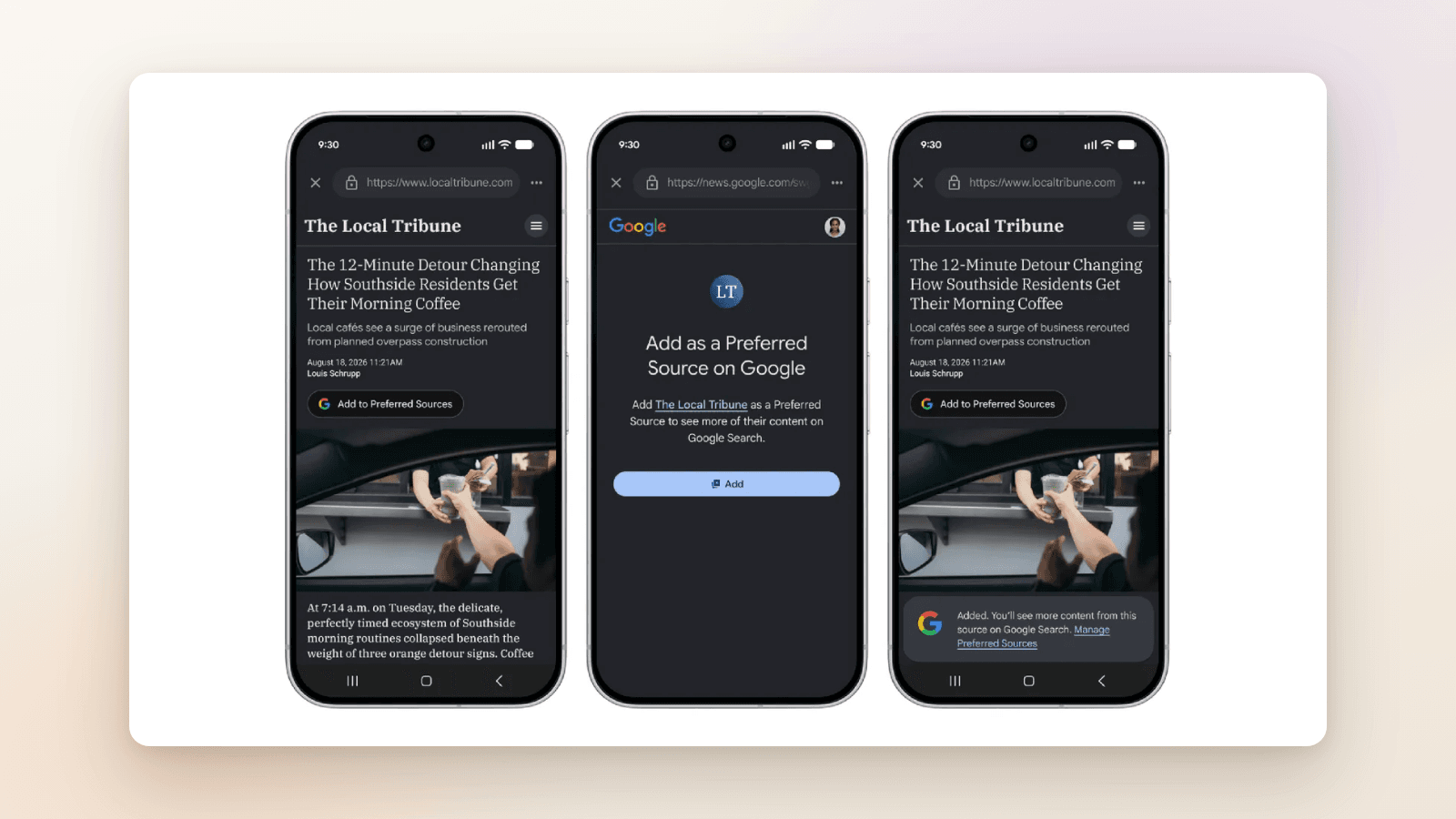
Most of what gets sold as "AI search optimization" right now is stuff Google has flat-out said does nothing. llms.txt files. Special AI markup. Rewriting your content "for the machines." I keep a running list of these myths in my breakdown of Google's AI optimization guide, and the list of things that actually move AI visibility stays stubbornly short.
On August 20, Google added something real to the short list. Quietly, in its own developer docs.
It's a button. Two lines of code. And unlike almost everything else in the AEO conversation, Google itself publishes the mechanism and the click data. It also has a limit that most of the people about to sell it to you will conveniently skip. Both halves matter, so let's do both.
What the Preferred Sources Button Actually Does
Quick timeline, because this rolled out in pieces:
- Preferred sources started as a Top Stories feature: readers pick the sites they trust, and Google shows those sites more often in that reader's results.
- May 27, 2026: Google extended preferred sources into AI Overviews and AI Mode. When a source you've picked shows up in an AI answer, it gets a visible "Preferred" badge so it stands out from the other citations.
- August 20, 2026: Google announced an embeddable button that any eligible site can drop on its own pages. A reader clicks it, confirms, and your site is added to their preferred list without them digging through Google's settings.
The whole implementation is two lines from Google's Search Central docs:
<script async src="https://news.google.com/swg/js/v1/publisher.js"></script>
<div google-add-preferred-source-btn></div>
That renders a Google-styled, auto-localized button on your page. There's a dark theme option, a language override, and a plain link version for sites that can't run JavaScript:
https://www.google.com/preferences/source?q=yourdomain.com
Two eligibility notes worth knowing before you touch anything. First, this works at the domain and subdomain level only. You can register yoursite.com or blog.yoursite.com, but not yoursite.com/blog. Second, the reader has to be signed into a Google account for the preference to stick, which most people on Chrome and Android already are.
Why This One Is Different
I'm hard on AEO tactics because most of them are vibes wearing a trench coat. Nobody selling llms.txt can show you a citation it earned. Nobody hand-tuning JSON-LD "for AI" can isolate what it changed. Google's own guidance says regular schema is enough and the special-AI-markup industry is noise. That's the whole reason I tell dentists to be skeptical of the AEO pitch.
Preferred sources is the opposite shape. Google states exactly what it does and attaches numbers to it:
- People are twice as likely to click through to a source they've marked as preferred. That's Google's own figure, not a vendor's.
- When Google announced the AI integration in May, readers had picked over 345,000 unique sources. By the August button announcement, that number was past 600,000. Adoption nearly doubled in three months.
- The badge shows up inside AI Overviews and AI Mode, which is exactly where clicks have been evaporating. If you've read my post on AI Mode becoming the default search experience, you know why a visual edge inside the AI answer is worth more than one below it.
There's no guesswork about the mechanism. Your site appears more often for that reader, it wears a badge in their AI results, and they click it about twice as often. Compare that to every other AEO tactic, where the mechanism is "trust me."
The Catch: It Only Works on People Who Already Know You
Here's the sentence that will be missing from every agency pitch deck by October: the button does nothing for people who haven't clicked it.
Preferred sources is per-reader personalization. It is not a ranking factor. When someone marks your site as preferred, your results change for that person. Nothing changes for the other eight billion people. Google isn't taking a tally of preference clicks and boosting you globally. The May announcement was explicit on this: the badge highlights sources a reader already chose. It doesn't change what gets cited for strangers.
So the honest math looks like this:
- If you have an audience: real people who read your stuff, subscribe to your newsletter, come back monthly, then this button converts that loyalty into permanently better placement and double the clicks every time those people search. That's a genuinely great trade for two lines of code.
- If you don't have an audience: the button is a light switch in an empty room. Nobody's there to flip it.
This is an amplifier, not an acquisition channel. It multiplies attention you've already earned. It can't manufacture attention you haven't.
Should Your Dental Practice Install the Preferred Sources Button?
Probably not, and I say that as someone whose job would be easier if I told you yes.
Think about how patients actually interact with your website. They Google you twice a year, not twice a week. Your growth comes from local-intent searches like "implant dentist near me," where the fight is your Google Business Profile, reviews, and service pages, not a loyalty badge in Top Stories. A patient who loves you refers their neighbor. They don't add your blog to their reading rotation.
So if an agency ever pitches you "preferred source optimization" as a line item on your practice's invoice, that's a red flag, and you can quote Google's own docs back at them.
The exceptions are the dental brands that actually publish:
- DSOs and groups running real content hubs with returning readers and email lists
- Dental media, podcasts, and newsletters whose whole business is repeat readership
- Clinicians with a real following: the course-selling, conference-speaking, 20k-newsletter crowd
- Anyone whose site is the product, which is why I'm installing it on this site and on dentalist.ai
For that group, this is a ten-minute job with a measurable payoff. For a five-op GP practice in the suburbs, your marketing dollars still belong in the unglamorous stuff that fills chairs.
How I'd Roll It Out
If you're in the "actually has an audience" camp, here's the playbook:
- Drop the embed at the end of your articles, where the people who just got value from you are. A reader who finished your post is exactly the person who'll click "prefer this source."
- Put the deeplink in your newsletter. Your email list is, by definition, your preferred audience. Ask them once.
- Don't slap it above the fold on your homepage. A preference request before you've delivered value is just another cookie banner to close.
- Set a calendar reminder to check your AI visibility. There's no publisher-facing counter yet, at least nothing I can find in Search Console today, so watch your branded clicks and your impressions in the Search Console AI performance reports instead and look for the trend.
I'm shipping the button on petejohnsoniv.com this week, then dentalist.ai. When there's enough data to say something honest about what it did, I'll write it up here, win or wash.
The Bigger Thing This Signals
Zoom out and this is Google admitting something important: in an AI-generated answer, the source becomes a brand choice. Google is letting users vote for the publishers they trust, badging those votes inside AI answers, and now handing publishers the ballot box to put on their own site.
That means the AI search game splits in two. One game is getting cited at all, which is still won with non-commodity content and boring technical fundamentals. The other game is being chosen repeatedly by the same humans, which is won with trust built over years. The button only pays out in the second game.
Build the audience first. Then, and only then, the two lines of code are free money.
If you want the version of this with slides and a Q&A, this is exactly the kind of thing I cover in my AI search talks for dental audiences.
Sources
- Personalize what you see on Google Search, News and Discover: Google, the August 20, 2026 announcement of the embeddable button and the 600,000+ selected sources figure.
- Guide to Preferred Sources in Google Search for Web Publishers: Google Search Central, implementation code, theming options, and domain-level eligibility rules.
- Google AI Overviews & AI Mode gain preferred sources: Search Engine Land, the May 27, 2026 expansion into AI surfaces, the 345,000 sources figure, and Google's twice-as-likely click-through claim.
- Google's guidance on optimizing for AI features: Google Search Central, the official word on what does not help AI visibility, including llms.txt and special AI markup.
Keep reading
All articlesWant to see this in action for your practice?
Book a free discovery call and I'll run a competitive analysis. On the house.
Book a Discovery Call