Dental Insurance Pages That Actually Rank: Delta Dental, MetLife, Aetna, and PPO Content Without Thin SEO Spam
Pete Johnson
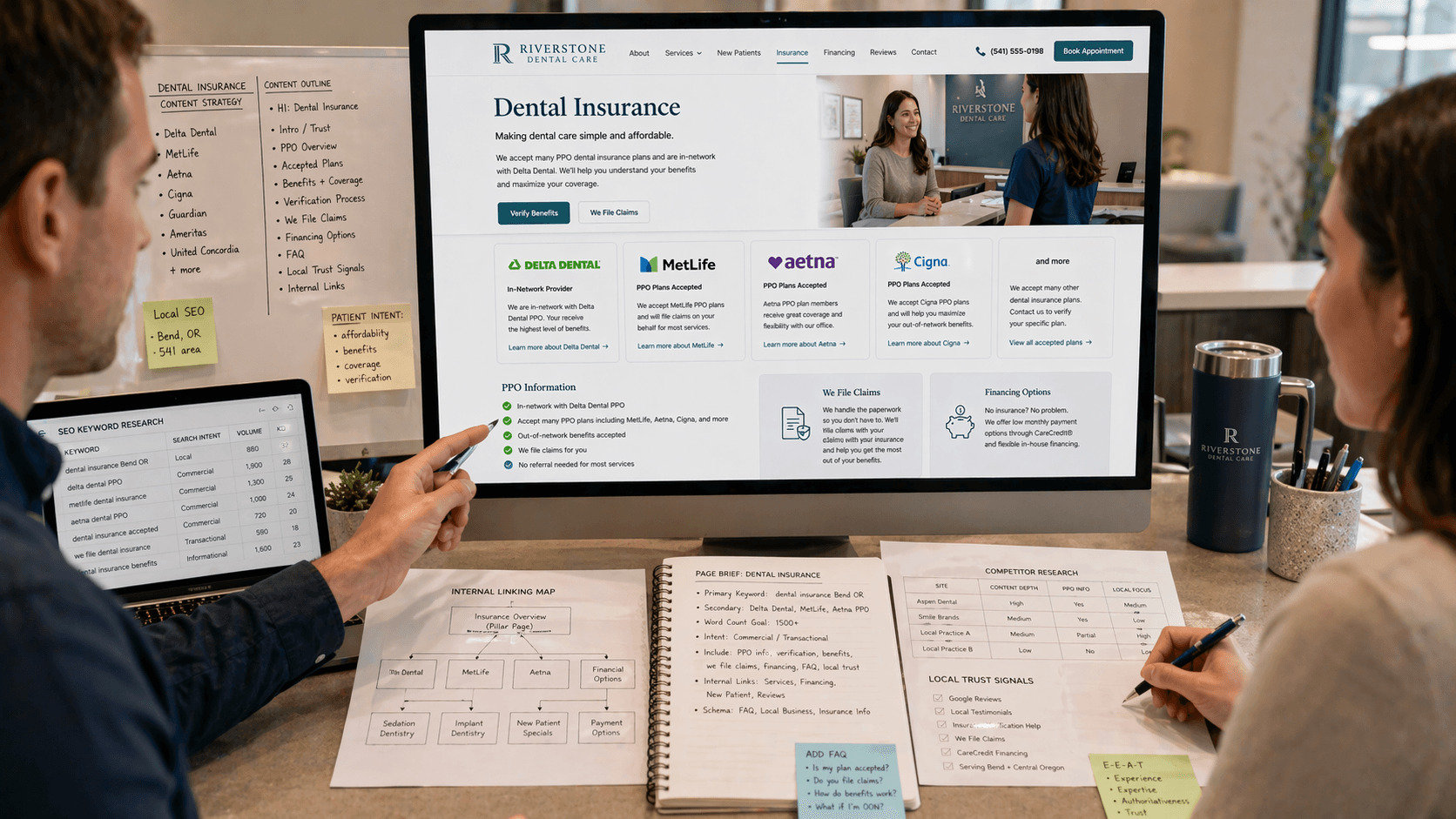
Let's talk about one of the ugliest content types in dental marketing:
insurance pages.
You know the ones.
They say things like:
We accept most major insurance plans including Delta Dental, MetLife, Cigna, Aetna, Guardian, Humana, United Concordia, Sun Life, Principal, Ameritas...
Then they dump 40 logos on the page, add zero explanation, and call it SEO.
That is not a strategy. That's a wallpaper choice.
The problem is that insurance content actually matters now. A lot.
Patients ask:
- "Do you take Delta Dental?"
- "Are you in network with Aetna?"
- "Can I still come if you're out of network?"
- "Will you file claims for me?"
And increasingly, they ask those questions inside AI tools before they ever call your office.
So the opportunity is real. But most practices approach it badly. They either:
- create one vague insurance page that answers nothing, or
- create a swarm of thin carrier pages that feel like doorway spam
There is a better way.
Here's how to build dental insurance pages that are actually useful, support search visibility, and help patients book.
Why Are Insurance Pages More Important Than They Used to Be?
Because insurance is one of the last high-friction trust questions in the patient journey.
Someone may love your reviews. They may like your website. They may even be ready to book.
Then they hit one unresolved question:
"Do you take my insurance?"
If the answer is hard to find, vague, or suspiciously evasive, they bounce.
That's true in regular search. It's even more true in AI-assisted search, where a patient can ask a chatbot to compare offices on insurance fit in a single follow-up question.
I touched on this in Google's AI Sidebar and Chrome Skills: What Dentists Need to Know: once AI stays in the browsing experience, your site has less room to be ambiguous.
Insurance content isn't glamorous. It's load-bearing. It's also one of the easiest ways to make your site more useful in AI-assisted discovery, which is why this topic pairs naturally with ChatGPT Local Search for Dentists.
What Makes Most Dental Insurance Pages Bad?
Usually one of three things.
1. They Are Too Vague
The page says "we accept most major PPO plans" and stops there.
That is not an answer.
Patients want specifics:
- which carriers
- what "accept" means
- whether you're in network
- whether you'll file claims
- whether financing is available if coverage is limited
2. They Try to Rank by Volume Instead of Helpfulness
This is where offices or agencies create:
- Delta Dental dentist in [city]
- Aetna dentist in [city]
- MetLife dentist in [city]
- Cigna dentist in [city]
but every page says the same 200 words with a logo swapped out.
That's not good SEO. It's doorway behavior in a nicer shirt.
3. They Avoid the Hard Conversation
Some offices are so afraid of saying the wrong thing that they say almost nothing at all.
I get it. Insurance details vary. Verification matters. Benefits change.
But silence is not clarity.
You can be accurate without being empty.
What Should a Good Dental Insurance Page Actually Do?
A strong insurance page should do four jobs.
1. Confirm Whether the Patient Is in the Right Place
Right away, the page should tell the user:
- whether you work with PPO plans
- whether you are in network with specific carriers if relevant
- whether you see out-of-network patients
This is not the place for coy copy.
2. Explain How Insurance Works at Your Office
Patients are often less confused about insurance itself than they are about how your office handles it.
The page should clarify:
- do you verify benefits before treatment?
- do you file claims on the patient's behalf?
- do you provide estimates?
- do you offer financing for uncovered treatment?
That level of clarity can close the gap between interest and booking. It is the same basic conversion principle behind Why Most Dental Websites Don't Convert: unresolved doubt kills action.
3. Support Search Intent Without Turning Into Spam
You do want relevant carrier names on the page if they genuinely apply.
You do not want to manufacture 25 useless pages with no unique value.
The best pages target real intent by being specific and helpful, not by stuffing carrier names into air.
4. Reduce Anxiety Around Cost
Insurance is really a cost question wearing a PPO badge.
A good insurance page should reassure people that:
- your team can help them understand benefits
- out-of-pocket estimates are available
- financing may be available when insurance doesn't cover everything
That is what patients are actually trying to learn.
Should You Have One Insurance Page or Multiple Carrier Pages?
This is the right question.
For most dental practices, the answer is:
Start with one strong master insurance page. Then create individual carrier pages only when there is real search demand and real content to support them.
Your master page should cover:
- PPO participation model
- key carriers you commonly work with
- claims process
- benefit verification
- financing fallback
- FAQs
Then, if a specific carrier matters enough in your market, build a dedicated page that is actually different.
For example, a real Delta Dental page might cover:
- whether you're in network with Delta PPO or Premier
- what new patients usually ask about Delta coverage
- preventive vs restorative expectations
- how your office verifies benefits
That is useful.
A clone page that just swaps "Delta" for "MetLife" is not.
What Sections Should Be on the Master Insurance Page?
If I were rebuilding one from scratch, here's the structure I'd use.
Section 1: Clear H1 and Summary
Something like:
Dental Insurance and PPO Information for Patients in [City]
Then a short summary:
We work with many PPO plans, help patients verify benefits, and file claims on their behalf. Coverage varies by plan, and our team can walk you through expected out-of-pocket costs before treatment.
Short. Clear. Adult.
Section 2: Which Plans You Commonly Work With
List the carriers that matter most to your market.
Not 90 logos.
Real text. Real explanation.
Example:
- Delta Dental
- MetLife
- Aetna
- Cigna
- Guardian
- Principal
If you are in network with some and out of network with others, say so clearly.
Section 3: How Insurance Works at Your Office
Answer practical questions:
- Do you verify benefits?
- Do you file claims?
- Can you provide treatment estimates?
- What happens if insurance pays less than expected?
This is where trust gets built.
Section 4: What If I'm Out of Network?
This section matters more than most practices realize.
Many patients assume "out of network" means "can't come here."
Explain the truth:
- many PPO patients still choose out-of-network offices
- benefits vary
- your office can often still file claims
- financing may help bridge the difference
Section 5: Financing and Payment Options
Insurance pages should not dead-end into uncertainty.
If financing is available, mention it.
If payment plans exist, mention them.
If membership plans exist, mention them.
Section 6: FAQ
This is where you catch the long-tail questions.
What Questions Should the FAQ Answer?
These are the big ones:
Do you take Delta Dental?
Answer it directly. If the answer depends on plan type, say that.
Are you in network with MetLife or Aetna?
Again: direct answer, then nuance.
Can I still come if you're out of network?
Yes, if true. And explain what that means operationally.
Will you file insurance claims for me?
Patients care about administrative friction more than marketers think. So does anyone comparing offices in local search, whether that comparison starts in Google or in AI-driven search behavior.
How do I know what my insurance will cover?
Explain benefit verification in plain language.
What if I don't have insurance?
This is a great place to mention financing or membership plans.
And yes, this question-led structure also makes your content easier for machines to interpret. Google killed the FAQ rich result, so the dropdown is gone from your listing, but the format still helps AI pull a clean answer off your page.
What Should an Individual Carrier Page Include?
Only build a dedicated carrier page if you can make it genuinely useful.
Let's say you decide to build:
Delta Dental Dentist in [City]
That page should not be a clone.
It should include:
- whether you're in network, out of network, or plan-dependent
- how your office handles Delta claims
- what Delta patients usually ask about exams, cleanings, crowns, or major work
- a clear benefits-verification disclaimer
- a CTA to call or book and check benefits
Same logic for MetLife, Aetna, or Cigna.
The page needs real intent resolution, not brand-name recycling.
How Do You Keep Insurance Pages Accurate Without Becoming a Lawyer?
Use two rules.
Rule 1: Be Helpful, Not Absolute
Don't promise specific coverage percentages unless you can guarantee them.
Say:
Coverage varies by employer plan and benefit schedule.
Say:
Our team can help verify benefits before treatment.
Do not say:
Your crown will be covered at 50%.
unless you are looking directly at the patient's plan details.
Rule 2: Use Strong Disclaimers Without Hiding Behind Them
You do need a verification disclaimer.
But don't let the disclaimer become the whole page.
The page should still answer the practical question:
"Can you help me use my insurance here?"
If the answer is yes, make that obvious.
What Does This Have To Do With SEO?
A lot, actually.
Insurance pages are local SEO assets because they line up with real patient language.
People search:
- Delta Dental dentist near me
- dentist that takes MetLife in [city]
- Aetna dentist [city]
- dentist that accepts PPO near me
If your office genuinely serves those patients and your content is good, these pages can become some of the highest-intent pages on your site.
They also strengthen your visibility in AI-assisted search because they answer a specific practical question in a machine-readable format.
That's the big point:
good insurance pages are not "extra SEO pages."
They're decision pages.
And decision pages tend to convert. They also support your broader local SEO because they answer one of the most common patient intent questions in plain language.
The Short Version
Most dental insurance pages fail because they're either vague or spammy.
The fix is not more logos. It's more clarity.
Build one strong insurance page first. Explain how your office handles PPO plans, claims, verification, out-of-network care, and financing. Add individual carrier pages only when you have real demand and real content. Use carrier names where they are truly relevant, but don't manufacture thin doorway pages just to chase keywords.
Patients want to know whether you can help them use their benefits.
Search engines and AI systems want clear, structured answers.
Give both what they want and the page will do its job.
Go deeper: More from the Local SEO hub: GBP, reviews, local pack rankings, and the signals that actually move patients.
Sources
- Removing the FAQ rich result: Google Search Central
- Local Business structured data: Google Search Central
Keep reading
All articlesWant to see this in action for your practice?
Book a free discovery call and I'll run a competitive analysis. On the house.
Book a Discovery Call