ChatGPT Local Search for Dentists: How to Show Up When Patients Ask AI Instead of Google
Pete Johnson
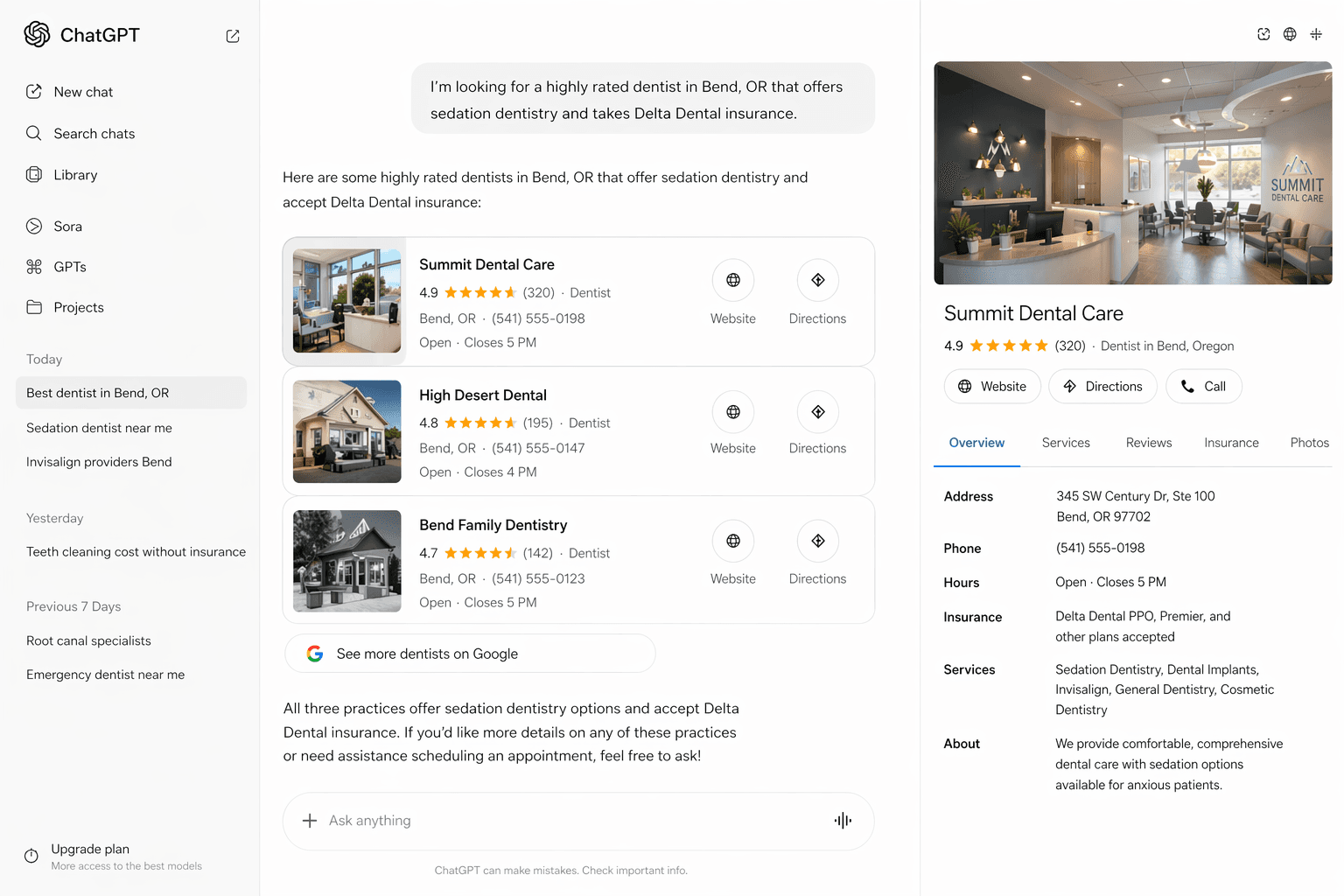
Here's the shift most dental practices still haven't clocked:
Some patients are no longer starting with Google.
They're opening ChatGPT and typing things like:
- "Find me a good sedation dentist near me"
- "Who's the best Invisalign dentist in Scottsdale?"
- "Which dentist near me takes Delta Dental and has good reviews?"
That doesn't mean Google is dead. It means the local search journey is starting to fragment. Google still matters enormously. Your Google Business Profile still matters enormously. But now there's another discovery layer sitting in front of the click.
If your practice wants to show up when patients ask AI instead of Google, you need to understand one thing:
ChatGPT doesn't "rank" local businesses the way Google does. It assembles answers from available signals.
And the practices with the cleanest, clearest, most consistent signals have a better shot at being included.
That's the game now. Here's how to play it.
Quick answer: ChatGPT doesn't rank local businesses the way Google does. It assembles answers from available signals, so the practices with the cleanest, most consistent signals get mentioned. Six things matter most: a complete Google Business Profile, explicit service pages for each treatment, reviews that mention specific services, consistent NAP data, clear insurance and financing answers, and structured data. None of it replaces Google SEO. It stacks on top of it.
Is ChatGPT Really Becoming a Local Search Tool?
Yes, at least for a growing slice of search behavior.
OpenAI launched ChatGPT search broadly in 2025, and since then the product has kept moving toward faster product discovery, better web answers, and a more integrated search experience. OpenAI has also made it clear that websites can appear in ChatGPT search results as long as they are crawlable and not blocking OpenAI's search crawler.
That matters because local intent doesn't always announce itself with a map anymore. Sometimes it looks like this:
"I'm nervous at the dentist. Can you help me find someone nearby who offers sedation?"
That's not a classic keyword query. It's conversational. It's messy. It's high intent.
And it maps perfectly to how people already talk to AI.
For a dental practice, the implication is simple: the inputs feeding AI discovery now matter almost as much as the rankings feeding old-school search.
How Does ChatGPT Decide Which Dentists to Mention?
At a high level, ChatGPT needs clear evidence about four things: who you are, where you are, what you do, and why a patient should trust you. The practices that make those four things explicit, consistent, and crawlable have a better shot at being included in answers.
This is where most people get sloppy. There is no public "local ranking checklist" from OpenAI for dentists. So anyone telling you they have the exact formula is selling incense. But we can make a pretty solid inference from what OpenAI has publicly documented and from how AI retrieval works in practice.
That evidence breaks down as:
- Who you are
- Where you are
- What you do
- Why a patient should trust you
That means the most likely winning signals are the boring ones most dental sites still screw up:
- clear service pages
- consistent name, address, and phone number
- crawlable website content
- strong review presence
- explicit insurance and financing information
- structured data that makes your site easy to parse
This is part of why LocalBusiness structured data and question-driven content matter. You're not just optimizing for a blue link. You're optimizing for machine-readable understanding.
If your site is vague, contradictory, or thin, AI has less to work with.
If your site is explicit, consistent, and useful, AI has more to quote, summarize, and trust.
What Signals Matter Most for ChatGPT Local Search?
Six signals matter most: a complete Google Business Profile, explicit service-led pages, reviews that mention specific services, NAP consistency, clear insurance and financing information, and structured data. If I were auditing a dental practice specifically for AI local visibility, these are the first six things I'd look at.
The six AI visibility signals
| Signal | Why it matters |
|---|---|
| Google Business Profile | The cleanest public record of your real-world details |
| Service-led pages | "Sedation dentistry" on its own page beats "comprehensive care for the whole family" |
| Specific reviews | "Got me in same day for emergency pain" beats "Wonderful office!" |
| NAP consistency | Mismatched data teaches machines not to trust your entity |
| Insurance and financing info | Patients ask AI practical questions; unanswered means ignored |
| Structured data | Content that's easy to parse is easier to reuse in an answer |
1. Your Google Business Profile Still Pulls a Ton of Weight
Even though this is a post about ChatGPT, your Google Business Profile is still foundational.
Why? Because your GBP is usually the cleanest public record of your practice's real-world details: practice name, address, phone, hours, services, reviews, and photos. It also tends to shape how your business information appears across the web.
If your GBP is incomplete or messy, it usually means the rest of your digital footprint is messy too.
So yes, if you want to show up in AI discovery, start by tightening the thing that already powers your local presence now. I broke that process down in Google Business Profile for Dentists: The Complete Optimization Guide.
2. Your Website Needs Explicit Service-Led Pages
This is where a lot of practices lose.
Their homepage says "comprehensive care for the whole family," which sounds nice but tells an AI almost nothing useful.
What ChatGPT can work with is specificity:
- sedation dentistry
- dental implants
- emergency dentistry
- Invisalign
- veneers
- same-day crowns
Every major service should have its own page. That page should say, in plain English, what the service is, who it's for, what problems it solves, and what the next step is.
If a patient asks ChatGPT, "Who offers sedation dentistry near me?" and your site never uses the words "sedation dentistry" clearly, you've made yourself harder to mention. That is exactly why service-page clarity matters, and it's why I wrote The Perfect Sedation Dentistry Page for 2026.
3. Reviews Need to Say More Than "Great Staff"
Reviews are no longer just star-count vanity.
They're language assets.
An AI system can learn more from:
"They helped me with emergency dental pain and got me in same day."
than from:
"Wonderful office!"
You can't script patient reviews, obviously. But you can build a review process that naturally pulls out specifics. The practices winning local search usually have patients mentioning:
- the service they received
- the insurance or financing experience
- the speed of scheduling
- anxiety or comfort
- the doctor or team by name
That is gold for both conversion and AI interpretation.
This is one reason review generation is no longer a side project. It's infrastructure.
4. NAP Consistency Still Matters
Your practice name, address, and phone number need to match everywhere important.
That's not a glamorous answer. It's still true.
If your site says one thing, your GBP says another, and three directory listings still show an old phone number, you are teaching machines not to trust your entity.
AI search doesn't magically rise above bad local hygiene. It inherits from it. If you need the full local-search cleanup playbook, start with Local SEO for Dentists: The Complete Guide for 2026.
5. Insurance and Financing Info Are More Important Than Most Dentists Think
Patients ask AI practical questions:
- "Does this dentist take Delta Dental?"
- "Do they offer payment plans?"
- "Will they see emergencies without insurance?"
If your website doesn't answer those questions, AI has to guess, deflect, or ignore you.
That is why I think insurance pages are going to become a much bigger local SEO lever over the next year. Not because they are sexy. Because they resolve doubt.
6. Structured Data Helps Machines Read You Faster
Structured data is not magic dust. But it helps.
Google explicitly documents LocalBusiness structured data as a way to help search engines understand details like hours, departments, and business identity. FAQ markup rules have narrowed over time, but a well-structured site with clear headings, answers, and entity data is still easier for machines to interpret than a vague wall of marketing copy.
Put differently: if your content is easy for a parser to understand, it is easier for an AI system to reuse.
What Do Most Dental Practices Get Wrong?
Usually some version of this: their marketing is full of branding language and empty on decision-making information. They lead with "compassionate care" and "modern dentistry" while the questions patients actually ask AI, insurance, sedation, how soon they can get in, sit buried or unanswered.
They say:
- compassionate care
- modern dentistry
- advanced technology
- patient-centered experience
Fine. Every other dentist says that too.
Meanwhile, the actual questions patients care about are buried or unanswered:
- What insurances do you take?
- Do you offer sedation?
- How soon can I get in?
- Do you treat kids?
- Do you do implants in-house?
- What happens if I have an emergency after hours?
- Are you fee-for-service or PPO?
When a patient asks ChatGPT those questions, the office with the clearest answers has a better chance of being surfaced.
This is the same thing I wrote about in Google's AI Sidebar and Chrome Skills: What Dentists Need to Know: AI is compressing the research process. You don't get infinite attention anymore. You get one shot to make yourself legible.
What Should a Dental Practice Change This Week?
Four moves: search for yourself in ChatGPT the way a nervous patient would, audit your top three revenue service pages, tighten your entity signals, and improve review specificity. Don't overcomplicate it. Start here.
Step 1: Search Yourself the Way a Nervous Patient Would
Open ChatGPT and try prompts like:
- "Find a sedation dentist near me"
- "Best emergency dentist in [city]"
- "Who takes Delta Dental near [city]?"
- "Find a dentist near me with good reviews for implants"
Look at the kinds of answers it gives. Look at what details are included. Look at whether your practice shows up at all.
If it doesn't, don't panic. Treat it like a diagnostic.
Step 2: Audit Your Service Pages
Pick your top three revenue services.
For each page, ask:
- Does the exact service name appear in the H1?
- Is the location context clear?
- Is the CTA obvious above the fold?
- Are the most common patient questions answered?
- Is insurance/financing mentioned if relevant?
- Is there a short, direct summary in the first paragraph?
If the answer to three or more of those is "no," the page needs work. And if one of those revenue pages is sedation, implants, or another trust-heavy service, you should almost certainly compare it against Why Most Dental Websites Don't Convert too.
Step 3: Tighten Your Entity Signals
Make sure the following are consistent:
- practice name
- address
- primary phone
- hours
- accepted insurance language
- doctor names
Your site, GBP, Apple Business, top directories, and major citations should not be improvising. The newer Apple Business for Dental Practices shift only makes those entity signals more important.
Step 4: Improve Review Specificity
Don't ask for "a review." Ask for honest feedback about the specific experience.
For example:
"If you mention what treatment you had or what stood out about the visit, that really helps other patients."
Still compliant. Still natural. Much better data.
Does ChatGPT Local Search Replace Google SEO?
No. It stacks on top of it.
This is the mistake agencies are about to make for the next 18 months. They'll pitch "AI SEO" like it's a brand new religion and quietly ignore the fact that the fundamentals still run the building.
If your local SEO is weak, your AI visibility is probably weak too.
If your GBP is strong, your reviews are specific, your service pages are clear, and your entity signals are tight, you are already building the kind of footprint AI systems can understand.
AI local search doesn't replace the basics.
It punishes you faster for skipping them.
The Short Version
Patients are starting to ask ChatGPT local-intent questions that used to go straight to Google. That doesn't mean you need a whole new marketing religion. It means you need cleaner signals.
Clear service pages. Better reviews. Explicit insurance info. Consistent business data. Structured content. A site that actually answers the questions patients ask.
That's how you improve your odds of being mentioned when AI becomes the front door to local discovery.
Got it? Good. Fix the boring stuff first.
Go deeper: AI in Dentistry · Local SEO
Going deeper on AI search? The Dental AEO Guide is the 6,000-word playbook on getting cited by ChatGPT, Perplexity, and Google AI Overviews: schema, content architecture, the 90-day implementation roadmap, and where AI search is going next.
Sources
- Introducing ChatGPT search: OpenAI
- Search product discovery in ChatGPT: OpenAI
- Shopping with ChatGPT Search: OpenAI Help Center
- Local Business structured data: Google Search Central
Keep reading
All articlesWant to see this in action for your practice?
Book a free discovery call and I'll run a competitive analysis. On the house.
Book a Discovery Call